Faith in God: Surrender, Action, and His Power at Work
Faith is central to the Christian life, yet many misunderstand how it works. Some believe faith means doing nothing at all and letting God do everything. Others think it means doing their best and asking God to fill in the gaps. Scripture gives a clearer picture: true faith means total surrender to God, while actively obeying Him, with the understanding that the strength, victory, and perfection come from Him alone.
Let us examine this through the Old Testament examples and the era of Christ’s grace, and see how man should properly understand faith in God.
1. The Old Testament: God’s Power, Man’s Obedience
a. Self-Reliance Always Failed
Israel often fell into defeat when they trusted in themselves or other nations:
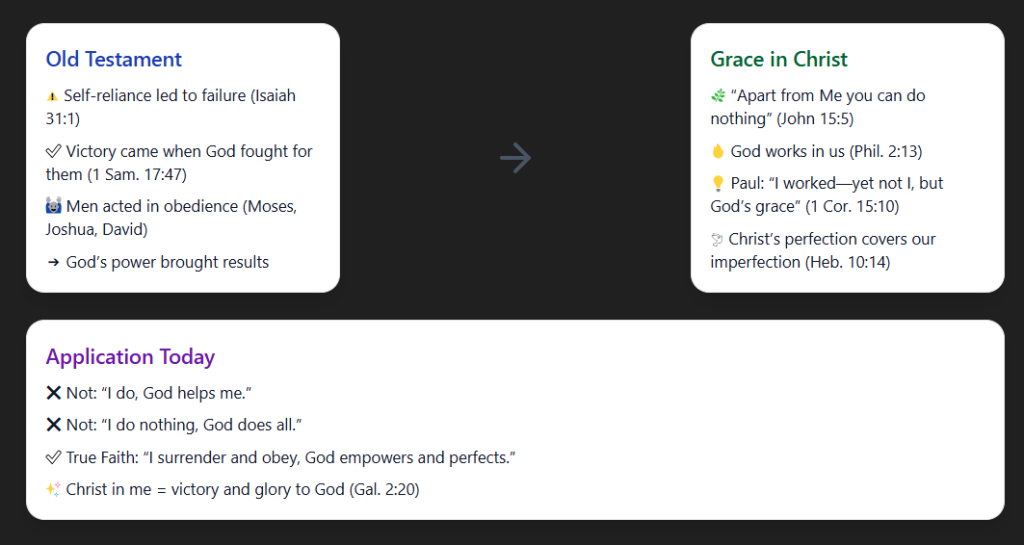
- “Woe to those who go down to Egypt for help, who rely on horses, who trust in the multitude of their chariots … but do not look to the Holy One of Israel.” (Isaiah 31:1)
b. God Alone is Perfect
- “As for God, His way is perfect.” (Psalm 18:30)
- Even the most righteous men admitted their imperfection: Isaiah cried, “Woe to me! I am ruined” (Isaiah 6:5), Job repented in dust and ashes (Job 42:6), and David begged for cleansing (Psalm 51).
c. But God Worked Through Men’s Actions
- Moses stretched out his staff and the sea parted (Exodus 14:21).
- Joshua and Israel marched around Jericho before the walls fell (Joshua 6:20).
- David slung a stone, but “the battle is the Lord’s.” (1 Samuel 17:47).
Lesson: Man must act in obedience, but victory comes from God’s power, not man’s ability.
2. The Era of Christ’s Grace: Christ in Us
a. Without Christ, Nothing Can Be Done
Jesus declared:
- “Apart from Me you can do nothing.” (John 15:5)
Paul affirms this:
- “It is God who works in you to will and to act in order to fulfill His good purpose.” (Philippians 2:13).
b. Christ is Our Perfection
- “I no longer live, but Christ lives in me.” (Galatians 2:20)
- “For by one sacrifice He has made perfect forever those who are being made holy.” (Hebrews 10:14)
Man is imperfect, but Christ living within believers makes them complete before God.
c. Grace Does Not Cancel Human Effort
Paul gives balance:
- “I worked harder than all of them—yet not I, but the grace of God that was with me.” (1 Corinthians 15:10)
We surrender, but that surrender is active:
- “Offer your bodies as a living sacrifice, holy and pleasing to God.” (Romans 12:1)
- “Be strong in the Lord and in His mighty power.” (Ephesians 6:10).
Faith is not passivity but empowered obedience.
3. Example of Peter Walking on Water
When Jesus called Peter to walk on the sea (Matthew 14:22–33):
- Peter trusted and stepped out of the boat, and he walked on water.
- But when he looked at the waves, fear replaced faith, and he sank.
- Jesus rescued him, saying: “You of little faith, why did you doubt?” (v. 31).
Lesson: Faith works when we fix our eyes on Christ. We act in obedience, but His power sustains us. The moment we rely on ourselves, fear and failure come.
4. The Balanced Biblical Truth
- False View #1: “I do, and God helps me finish.” → This still puts man at the center.
- False View #2: “I do nothing, God does all.” → This denies the call to obedience and action.
- True View (Biblical): “God works in me; I surrender and obey. My action is real, but the power and perfection come from Him.”
As Paul summarized:
“I worked—yet not I, but the grace of God that was with me.” (1 Corinthians 15:10)
Conclusion
Faith in God means:
- Surrendering our self-reliance.
- Obeying God’s commands in action.
- Trusting that His strength, not ours, brings victory.
- Acknowledging that His perfection in Christ covers our imperfection.
Thus, the believer can say:
- Not “I can do with God,”
- But “Christ in me does the work, to the glory of God.”