
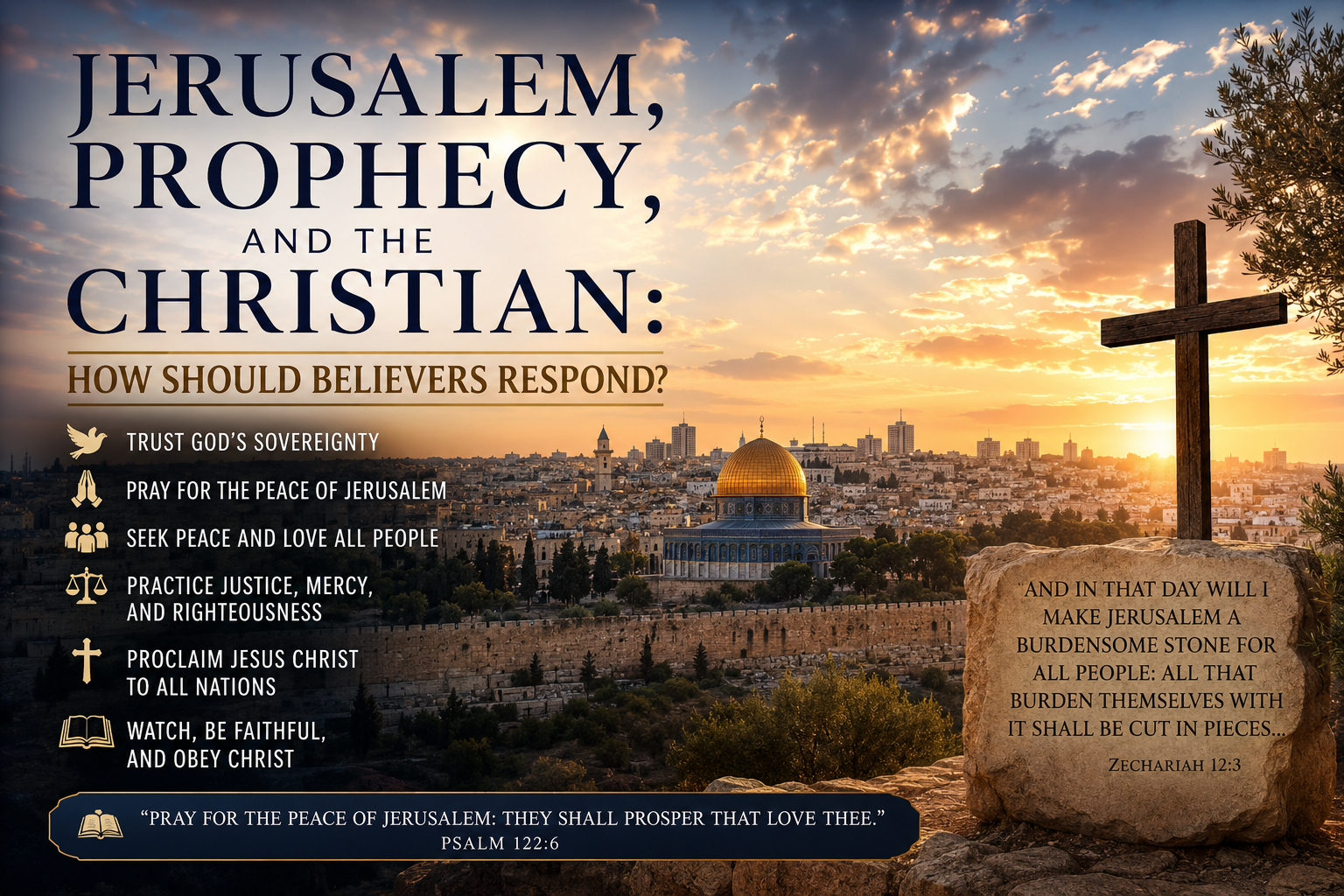
Jerusalem, Prophecy, and the Christian: How Should Believers Respond?
Jerusalem holds a unique place in biblical prophecy. Scripture says that God will make Jerusalem “a burdensome stone” to the nations, and it also says that God Himself will gather the nations against Jerusalem.
This raises an important question:
If both events are within the sovereign will of God, what should Christians do?
The answer must not be built on nationalism, political ideology, fear, speculation, or attempts to force prophecy into current events. It must come from Scripture.
The biblical pathway is remarkably clear:
God fulfills prophecy. Christians obey God.
Believers are not commissioned to manufacture prophetic events. They are called to remain faithful to Christ while God sovereignly accomplishes His purposes in history.
God Says He Will Make Jerusalem a Burdensome Stone
Zechariah declares:
Zechariah 12:3
“And in that day will I make Jerusalem a burdensome stone for all people: all that burden themselves with it shall be cut in pieces, though all the people of the earth be gathered together against it.”
The key words are:
“I will make.”
Jerusalem does not become a burdensome stone simply because of political power, military strength, economic influence, or geography.
God says that He will make Jerusalem so.
The meaning is reinforced later in the chapter:
Zechariah 12:9
“And it shall come to pass in that day, that I will seek to destroy all the nations that come against Jerusalem.”
The prophecy therefore presents Jerusalem as a place around which the nations become entangled, while God Himself remains sovereign over the outcome.
God Also Says He Will Gather the Nations Against Jerusalem
Zechariah later says:
Zechariah 14:2
“For I will gather all nations against Jerusalem to battle…”
Again, God says:
“I will.”
This creates an apparent tension.
God makes Jerusalem a burdensome stone.
God gathers the nations against Jerusalem.
Then God judges the nations that come against Jerusalem.
The very next verse says:
Zechariah 14:3
“Then shall the LORD go forth, and fight against those nations, as when he fought in the day of battle.”
How can God sovereignly gather nations and yet judge them for what they do?
The Bible gives us an important principle for understanding this.
God Can Sovereignly Use Human Evil Without Approving Human Evil
The clearest biblical example is the crucifixion of Jesus Christ.
Peter said:
Acts 2:23
“Him, being delivered by the determinate counsel and foreknowledge of God, ye have taken, and by wicked hands have crucified and slain.”
Two truths appear in the same verse.
The death of Christ occurred according to:
“the determinate counsel and foreknowledge of God.”
Yet those who crucified Him acted with:
“wicked hands.”
God’s sovereignty did not remove human responsibility.
The same principle appears in the betrayal of Christ.
Jesus said:
Matthew 26:24
“The Son of man goeth as it is written of him: but woe unto that man by whom the Son of man is betrayed!”
Again, both truths remain.
“As it is written” means the event was already within God’s revealed prophetic purpose.
Yet:
“Woe unto that man” means the person committing the evil was still morally responsible.
This principle is essential when reading Jerusalem prophecy.
The fact that God has foretold an evil event never gives Christians permission to participate in that evil.
Prophecy tells us what God will sovereignly bring to pass.
God’s commandments tell us how we are to live.
Those two things must never be confused.
“I Will Gather the Nations” Is Not a Command to Christians
When God says:
“I will gather all nations against Jerusalem…”
He is describing what He will do sovereignly.
He is not commanding Christians to gather against Jerusalem.
Nor is He instructing Christians to support evil simply because they believe it may contribute to prophetic fulfillment.
In fact, the nations gathered against Jerusalem are later opposed by God Himself.
Zechariah 14:3
“Then shall the LORD go forth, and fight against those nations…”
Therefore the Christian cannot reason:
“Since prophecy says this must happen, we should help make it happen.”
That would be a serious misuse of prophecy.
Christians are never instructed to create the evil that Scripture predicts.
God fulfills prophecy.
Christians obey His commands.
The Christian’s First Responsibility: Seek Peace
Jesus said:
Matthew 5:9
“Blessed are the peacemakers: for they shall be called the children of God.”
Paul wrote:
Romans 12:18
“If it be possible, as much as lieth in you, live peaceably with all men.”
Therefore the Christian response to prophecy concerning conflict is not to ask:
How can this conflict be accelerated?
The proper question is:
How can I remain obedient to Christ while God fulfills His purposes?
Being a peacemaker does not mean denying prophecy.
It means refusing to commit evil in the name of prophecy.
God controls history.
The Christian is called to faithfulness within history.
Pray for the Peace of Jerusalem
Scripture gives believers a direct instruction:
Psalm 122:6
“Pray for the peace of Jerusalem: they shall prosper that love thee.”
That alone should greatly influence the Christian posture toward Jerusalem.
We are told to pray for Jerusalem, not to desire its destruction.
Yet biblical prayer should go deeper than political security.
Christians should pray for:
peace,
justice,
mercy,
truth,
protection of innocent life,
repentance,
and salvation.
Paul also wrote:
1 Timothy 2:1–2
“I exhort therefore, that, first of all, supplications, prayers, intercessions, and giving of thanks, be made for all men;
For kings, and for all that are in authority…”
Christian prayer therefore extends beyond one nation or one people.
It includes rulers, nations, civilians, enemies, victims, and all who are affected by conflict.
Reject Hatred Toward the Jewish People
Paul specifically warned Gentile believers concerning Israel.
Romans 11:18
“Boast not against the branches.”
And:
Romans 11:20
“Be not highminded, but fear.”
He also wrote:
Romans 11:28
“…as touching the election, they are beloved for the fathers’ sakes.”
Whatever one’s interpretation of end-times prophecy, Scripture gives no basis for antisemitism, contempt, or racial hostility toward Jewish people.
But the command to love does not stop there.
Christians are equally forbidden to hate Palestinians, Arabs, Muslims, or any other people.
Jesus said:
Matthew 5:44
“Love your enemies, bless them that curse you, do good to them that hate you, and pray for them which despitefully use you, and persecute you.”
Biblical prophecy never gives Christians permission to hate an ethnic group.
Christian conduct must remain governed by Christ.
Do Not Confuse God’s Prophetic Purpose With Approval of Every Human Action
This distinction is necessary.
The fact that God has prophetic purposes concerning Jerusalem does not mean that every action carried out by a government, military, political movement, or religious group associated with Jerusalem is automatically righteous.
The Bible itself repeatedly judged Israel and Judah for wrongdoing.
God said:
Isaiah 1:17
“Learn to do well; seek judgment, relieve the oppressed, judge the fatherless, plead for the widow.”
And:
Micah 6:8
“He hath shewed thee, O man, what is good; and what doth the LORD require of thee, but to do justly, and to love mercy, and to walk humbly with thy God?”
Therefore Christians can believe that Jerusalem has a real place in biblical prophecy while still judging human behavior according to biblical standards.
Those standards remain:
truth, justice, mercy, righteousness, and love of neighbor.
Prophecy does not suspend morality.
Jerusalem and the Modern State of Israel Are Not Automatically Identical Terms
Care is also needed when interpreting the word Jerusalem.
Zechariah 12 itself distinguishes between Jerusalem and Judah.
Zechariah 12:2
“…in the siege both against Judah and against Jerusalem.”
Again:
Zechariah 12:5
“And the governors of Judah shall say in their heart, The inhabitants of Jerusalem shall be my strength…”
So in the immediate context, Jerusalem is specifically Jerusalem.
Yet Jerusalem can also represent the wider covenant people in prophetic and poetic language.
For example:
Zephaniah 3:14
“Sing, O daughter of Zion; shout, O Israel; be glad and rejoice with all the heart, O daughter of Jerusalem.”
Here Zion, Israel, and Jerusalem are closely related.
Therefore Christians should avoid two opposite errors.
We should not separate Jerusalem completely from Israel’s wider biblical identity.
But neither should we automatically replace every reference to Jerusalem with:
“the modern State of Israel.”
The text must be allowed to define its own meaning.
Jerusalem Itself Is Called to Repentance
Another crucial point is often overlooked.
Zechariah does not merely describe Jerusalem being defended.
The prophecy moves toward repentance.
God says:
Zechariah 12:10
“And I will pour upon the house of David, and upon the inhabitants of Jerusalem, the spirit of grace and of supplications: and they shall look upon me whom they have pierced…”
The New Testament directly connects this prophecy with Jesus Christ.
John 19:37
“They shall look on him whom they pierced.”
Revelation also uses the same language:
Revelation 1:7
“Behold, he cometh with clouds; and every eye shall see him, and they also which pierced him…”
Therefore Jerusalem’s prophetic story is not merely about military preservation.
It leads toward recognition of the Messiah.
Zechariah continues:
Zechariah 13:1
“In that day there shall be a fountain opened to the house of David and to the inhabitants of Jerusalem for sin and for uncleanness.”
Jerusalem is therefore not presented as morally perfect simply because God has a purpose concerning it.
Jerusalem itself needs:
grace, repentance, mourning, cleansing, and reconciliation with God.
That deeply affects how Christians should pray.
We should not merely pray:
“Protect Jerusalem.”
We should also pray for the greater biblical purpose:
repentance and recognition of Jesus Christ.
The Christian Mission Remains the Gospel
Jesus did not commission His church to manage prophetic geopolitics.
He commissioned believers to make disciples.
Matthew 28:19
“Go ye therefore, and teach all nations…”
And:
Acts 1:8
“Ye shall be witnesses unto me…”
Paul summarized the gospel mission this way:
Romans 1:16
“For I am not ashamed of the gospel of Christ: for it is the power of God unto salvation to every one that believeth; to the Jew first, and also to the Greek.”
The church’s responsibility toward Jews and Gentiles remains fundamentally the same:
proclaim Christ.
Christians are not commissioned to manipulate borders, armies, wars, or diplomatic events to bring prophecy to completion.
We are commissioned to bear witness to Jesus Christ.
Do Not Try to Force God’s Prophetic Timetable
This principle appears clearly in Acts.
The disciples asked Jesus:
Acts 1:6
“Lord, wilt thou at this time restore again the kingdom to Israel?”
Jesus answered:
Acts 1:7
“It is not for you to know the times or the seasons, which the Father hath put in his own power.”
Then He immediately redirected them:
Acts 1:8
“But ye shall receive power… and ye shall be witnesses unto me…”
This is a powerful pattern.
The disciples asked about prophetic timing.
Jesus redirected them toward faithful witness.
God controls:
the times,
the seasons,
the nations,
and the fulfillment of prophecy.
Christians are responsible for:
obedience,
holiness,
witness,
prayer,
justice,
mercy,
and love.
Watch Prophecy Without Becoming Obsessed With Political Speculation
Christians are commanded to watch.
Jesus said:
Matthew 24:42
“Watch therefore: for ye know not what hour your Lord doth come.”
But biblical watchfulness is not merely watching wars, governments, elections, alliances, and headlines.
Jesus connects watchfulness with faithfulness.
Matthew 24:46
“Blessed is that servant, whom his lord when he cometh shall find so doing.”
The purpose of prophecy is therefore not merely to produce people who are skilled at identifying possible signs.
Prophecy should produce believers who are:
faithful, holy, sober, obedient, hopeful, and ready for Christ.
God Rules the Nations
Zechariah’s prophecy ultimately rests upon the sovereignty of God.
Scripture repeatedly declares that God rules over kings and nations.
Daniel 2:21
“And he changeth the times and the seasons: he removeth kings, and setteth up kings…”
And:
Psalm 22:28
“For the kingdom is the LORD’S: and he is the governor among the nations.”
Isaiah records God’s declaration:
Isaiah 46:9–10
“I am God, and there is none like me,
Declaring the end from the beginning…
My counsel shall stand, and I will do all my pleasure.”
Christians therefore do not need to engineer prophecy on God’s behalf.
God is fully capable of accomplishing everything He has spoken.
A Clear Biblical Pathway for Christians
The biblical response can be stated simply.
God says:
“I will make Jerusalem a burdensome stone.”
— Zechariah 12:3
Therefore:
Trust God’s sovereignty.
God says:
“I will gather all nations against Jerusalem.”
— Zechariah 14:2
Therefore:
Do not attempt to manufacture prophecy.
God says He will judge the nations that come against Jerusalem.
Therefore:
Do not commit evil simply because evil has been prophesied.
Jesus says:
“Blessed are the peacemakers.”
— Matthew 5:9
Therefore:
Seek peace.
Scripture says:
“Pray for the peace of Jerusalem.”
— Psalm 122:6
Therefore:
Pray.
Jesus says:
“Love your enemies.”
— Matthew 5:44
Therefore:
Reject ethnic hatred.
Scripture says:
“Do justly… love mercy…”
— Micah 6:8
Therefore:
Judge human actions according to God’s righteousness.
Zechariah says:
“They shall look upon me whom they have pierced.”
— Zechariah 12:10
Therefore:
Pray for repentance and recognition of the Messiah.
Jesus says:
“Ye shall be witnesses unto me.”
— Acts 1:8
Therefore:
Proclaim Christ.
Prophecy Is Not a Command to Commit the Evil It Predicts
This may be the most important principle in the entire discussion.
God may prophesy:
wars,
betrayal,
persecution,
apostasy,
judgment,
and nations gathering against Jerusalem.
But Christians are never commanded to participate in evil so that prophecy can be fulfilled.
Matthew 26:24 gives one of the clearest biblical examples:
“The Son of man goeth as it is written of him: but woe unto that man by whom the Son of man is betrayed!”
The event was prophesied.
The betrayal was still sinful.
Therefore:
What God has predicted is not necessarily what God has commanded Christians to perform.
Prophecy tells us what God will accomplish.
Commandments tell us how believers must act.
The Christian’s responsibility is obedience.
The fulfillment of prophecy belongs to God.
Conclusion: God Moves History; Christians Remain Faithful
The Bible gives Christians a balanced position concerning Jerusalem.
We should neither despise Jerusalem nor idolize it.
We should neither ignore prophecy nor attempt to force prophecy.
We should neither hate Israel’s enemies nor excuse injustice committed by anyone.
Instead, Scripture calls Christians to:
trust God’s sovereignty,
pray for Jerusalem,
seek peace,
love all people,
reject hatred,
practice justice and mercy,
pray for repentance,
proclaim Christ,
remain spiritually watchful,
and leave prophetic fulfillment in God’s hands.
God says:
“I will make Jerusalem a burdensome stone.”
God says:
“I will gather all nations against Jerusalem.”
The Christian response is not to attempt to take God’s role.
Our responsibility is to obey what He has commanded.
As Jesus prayed:
Luke 22:42
“Nevertheless not my will, but thine, be done.”
Christians are not called to move the pieces of prophecy.
God moves history.
Our calling is to remain faithful to Christ within it.
For christ.ph, a suitable SEO title would be “Jerusalem Prophecy and the Christian: How Should Believers Respond?” and a concise meta description could be: “What should Christians do about biblical prophecy concerning Jerusalem? A Scripture-based study of Zechariah 12–14, peace, prayer, Israel, prophecy, and the Christian mission.”