

The Harmony of Worship in Scripture: From Altars to Spirit and Truth
Introduction
Worship is one of the central themes of Scripture, weaving through the lives of the patriarchs, the covenant law, the psalms, the prophets, the exile and restoration, and finally the New Testament revelation in Christ. Although the outward expressions of worship changed across biblical history, the heart of worship—honoring, obeying, and loving the one true God—remained the same.
This article summarizes and harmonizes the biblical principles of worship, showing their progression from Old Testament patterns to New Testament fulfillment.
1. Worship in the Patriarchal Era: Altars and Sacrifice
In the days of Abraham, Isaac, and Jacob, worship was expressed primarily through altars, sacrifices, and calling on the name of the LORD.
- “Then the LORD appeared to Abram and said, ‘To your offspring I will give this land.’ So he built there an altar to the LORD, who had appeared to him.” (Genesis 12:7)
Principle: Worship is about acknowledging God’s presence, giving Him honor, and trusting His promises. It was simple, personal, and rooted in obedience.
2. Worship under the Law: The Tabernacle and Temple
Through Moses, God gave Israel a structured system of worship involving priests, sacrifices, offerings, and sacred space.
- “Let them make me a sanctuary, that I may dwell in their midst. Exactly as I show you concerning the pattern of the tabernacle… so you shall make it.” (Exodus 25:8–9)
Principle: Worship is holy and must be approached on God’s terms, not man’s. God is holy, and His people must approach Him through atonement and obedience.
3. Worship in the Kingdom: Psalms and the Temple
With David and Solomon, worship became both corporate and expressive, combining the temple sacrifices with psalms, music, and national festivals.
- “Oh come, let us worship and bow down; let us kneel before the LORD, our Maker!” (Psalm 95:6)
Principle: Worship is joyful, reverent, and expressive of both individual and community devotion. It involves the whole person—heart, voice, and posture.
4. The Prophets: Calling Out False Worship
As Israel drifted into idolatry, the prophets reminded the people that outward rituals without obedience were worthless.
- “What to me is the multitude of your sacrifices? says the LORD… Bring no more vain offerings… Wash yourselves; make yourselves clean; remove the evil of your deeds from before my eyes; cease to do evil, learn to do good.” (Isaiah 1:11, 13, 16–17)
Principle: True worship is not empty ritual but obedience and righteousness. God desires the heart, not just ceremony.
5. Exile and Return: Purified Worship
After judgment and exile, leaders like Ezra and Nehemiah restored true worship by reading God’s law, renewing the covenant, and cleansing the temple.
- “All the people gathered as one man into the square… and they told Ezra the scribe to bring the Book of the Law of Moses that the LORD had commanded Israel. So Ezra the priest brought the Law before the assembly… and he read from it.” (Nehemiah 8:1–3)
Principle: Worship must be centered on God’s Word and renewed hearts. It calls people back to covenant faithfulness.
6. New Testament Fulfillment: Worship in Spirit and Truth
With Christ’s coming, worship shifted from physical temples and sacrifices to the spiritual worship of God’s people, made possible through Christ’s sacrifice and the Holy Spirit.
- “God is spirit, and those who worship him must worship in spirit and truth.” (John 4:24)
- “I appeal to you… to present your bodies as a living sacrifice, holy and acceptable to God, which is your spiritual worship.” (Romans 12:1)
Principle: True worship is inward and spiritual, flowing from a heart transformed by Christ, expressed in obedience, praise, thanksgiving, and holy living.
Harmonizing the Principles
When we put these stages together, a unified theme emerges:
- Patriarchs – Worship begins with personal faith and obedience.
- Law & Temple – Worship requires holiness and atonement.
- Kings & Psalms – Worship is corporate, joyful, and expressive.
- Prophets – Worship must be sincere, not empty ritual.
- Exile & Return – Worship calls for repentance and renewal by the Word.
- New Testament – Worship is spiritual, Christ-centered, and life-encompassing.
Though the forms evolved, the essence remained: God desires worship from a sincere heart, in obedience to His Word, focused on Him alone.
Conclusion
The Bible shows that worship is not confined to a place, a ritual, or a song. It is the whole life lived in devotion to God. From Abraham’s altar to the psalms of David, from the rebuke of the prophets to the Spirit-filled worship of the early church, one truth resounds:
True worship is loving, obeying, and glorifying God with all our heart, soul, mind, and strength.
Table: False Worship vs. True Worship
| Aspect | False Worship (Rejected by God) | True Worship (Accepted by God) |
|---|---|---|
| Object of Worship | “You shall not make for yourself a carved image, or any likeness… You shall not bow down to them or serve them.” (Exodus 20:4–5) | “You shall worship the LORD your God, and Him only shall you serve.” (Matthew 4:10) |
| Heart Condition | “This people draws near to me with their mouth and honors me with their lips, but their heart is far from me; in vain do they worship me.” (Matthew 15:8–9; Isaiah 29:13) | “You shall love the LORD your God with all your heart, and with all your soul, and with all your might.” (Deuteronomy 6:5) |
| Form of Worship | “These people… worshiped the work of their own hands, that which their own fingers had made.” (Isaiah 2:8) | “God is Spirit, and those who worship Him must worship in spirit and truth.” (John 4:24) |
| Sacrifice | “Has the LORD as great delight in burnt offerings and sacrifices, as in obeying the voice of the LORD? Behold, to obey is better than sacrifice.” (1 Samuel 15:22) | “Present your bodies a living sacrifice, holy, acceptable to God, which is your reasonable service.” (Romans 12:1) |
| Praise | “When you come to appear before me, who has required of you this trampling of my courts? Bring no more vain offerings… I cannot endure iniquity and solemn assembly.” (Isaiah 1:12–13) | “Enter his gates with thanksgiving, and his courts with praise! Give thanks to him; bless his name!” (Psalm 100:4) |
| Posture/Attitude | “At that time men began to call upon the name of the LORD. Then mankind profaned the name of the LORD.” (Genesis 4:26, some versions: men began to call idols by God’s name) | “Oh come, let us worship and bow down; let us kneel before the LORD, our Maker!” (Psalm 95:6) |
| Fruit/Result | “They worshiped and served the creature rather than the Creator, who is blessed forever.” (Romans 1:25) | “Through Him then let us continually offer up a sacrifice of praise to God, that is, the fruit of lips that acknowledge his name.” (Hebrews 13:15) |
Summary:
- False worship is idolatrous, external, and hypocritical—lips without heart, rituals without obedience, devotion to created things instead of the Creator.
- True worship is obedient, heartfelt, spiritual, and Christ-centered, giving all glory to God alone.
Table: Biblical Examples of Worship
| Type of Worship | Example | Scripture | Key Point |
|---|---|---|---|
| False Worship | Golden Calf – Israel worshiped a calf made from gold instead of God. | Exodus 32:4–8 | Idolatry provoked God’s anger even when people claimed it was “a feast to the LORD.” |
| Baal Worship – Israel turned to Baal, offering sacrifices and even children. | Judges 2:11–13; 1 Kings 18:18–19 | False gods led Israel into destruction and God raised prophets to call them back. | |
| Asherah Poles – Pagan fertility worship under trees and carved poles. | Deuteronomy 16:21; 2 Kings 23:6–7 | Mixing pagan rituals with God’s worship was forbidden. | |
| Nadab & Abihu’s Strange Fire – Priests offered unauthorized fire before the LORD. | Leviticus 10:1–2 | Even priests were punished for inventing their own form of worship. | |
| King Jeroboam’s Golden Calves at Bethel & Dan | 1 Kings 12:28–30 | False altars led Israel into continual sin. | |
| True Worship | Abraham – Built altars and called on the name of the LORD. | Genesis 12:7–8 | Worship expressed by obedience, sacrifice, and faith. |
| Moses & Israel at the Red Sea – Sang praise after deliverance. | Exodus 15:1–2 | Worship through thanksgiving and song after God’s mighty acts. | |
| David – Worshiped with psalms, instruments, and heartfelt devotion. | Psalm 95:6; Psalm 100 | Worship as joy, humility, and heartfelt praise. | |
| Hezekiah’s Reforms – Cleansed the temple and restored true worship. | 2 Chronicles 29:20–30 | True worship is purified and centered on God’s commands. | |
| Early Church – Continued steadfastly in prayer, teaching, fellowship, and breaking of bread. | Acts 2:42–47 | True worship centered on Christ, the Word, prayer, and community. |
Key Lesson:
- False worship often involved idols, human inventions, or empty rituals, which always led to judgment.
- True worship was marked by obedience, purity, thanksgiving, sacrifice, and devotion to God alone—whether by Abraham, David, faithful kings, or the early church.
Here’s the updated timeline chart with key verses under each stage of worship in Scripture:
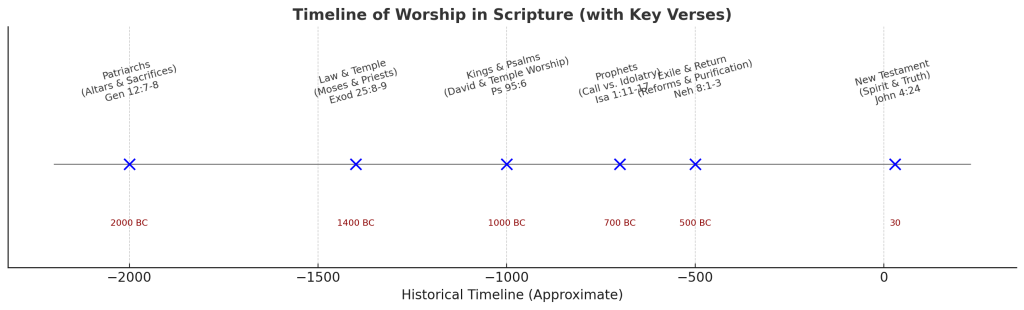
- Patriarchs (Altars & Sacrifices) – Genesis 12:7–8
- Law & Temple (Moses & Priests) – Exodus 25:8–9
- Kings & Psalms (David & Temple Worship) – Psalm 95:6
- Prophets (Call vs. Idolatry) – Isaiah 1:11–17
- Exile & Return (Reforms & Purification) – Nehemiah 8:1–3
- New Testament (Spirit & Truth) – John 4:24