
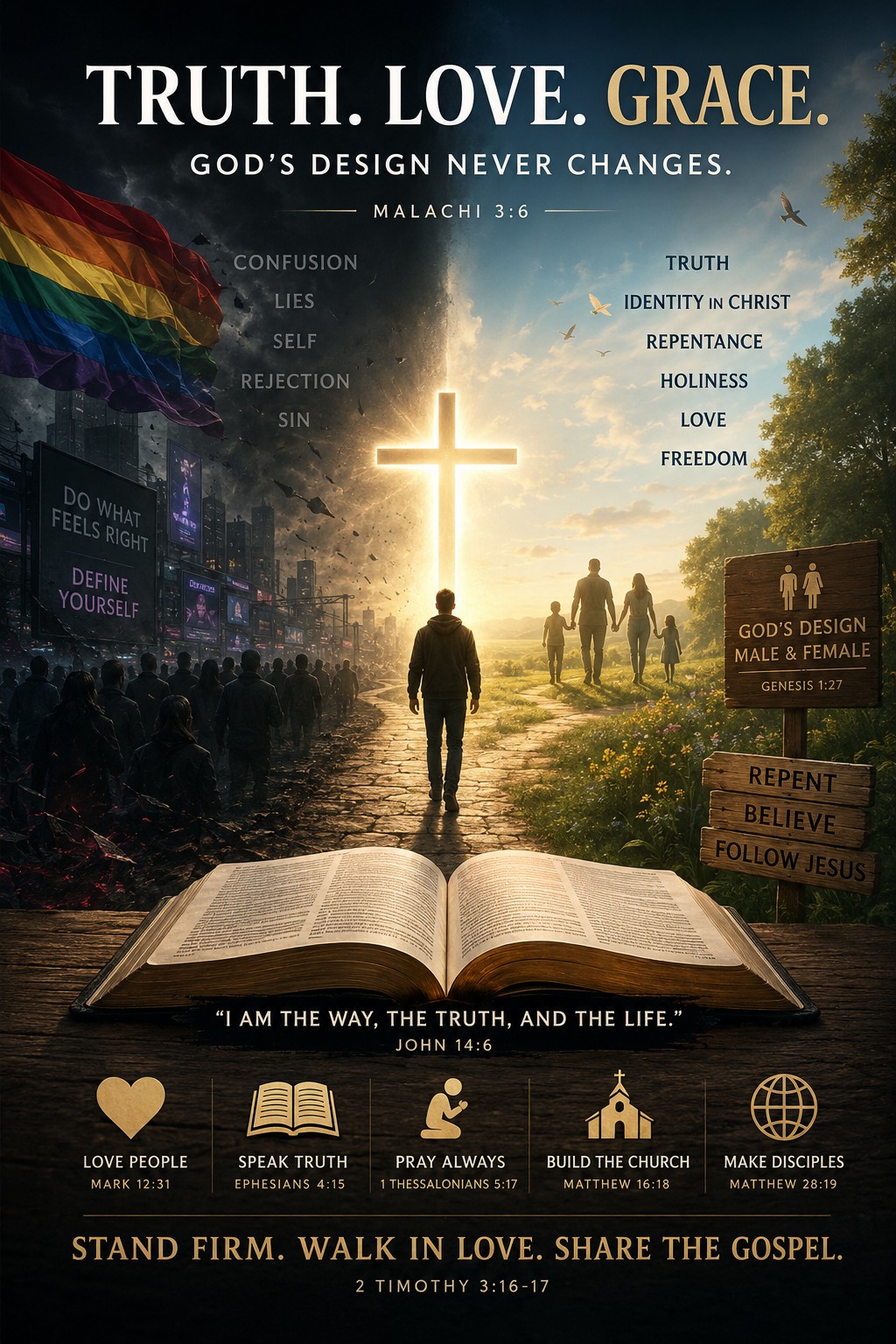
God’s Truth, Human Dignity, Repentance, and Grace
A Biblical Guide for Believers in a Time of Confusion About Sexuality, Identity, and Moral Authority
Purpose and spirit of this guide
This discussion seeks to present the Bible’s teaching faithfully while also reflecting the character of Christ. It is not written to mock, threaten, shame, or dehumanize anyone. Every human being bears God’s image and must be treated with dignity, truthfulness, patience, and love.
The phrase “rainbow ideology” is used here only to refer to cultural claims that personal desire, self-definition, or social approval determine moral truth over and above God’s created order and revealed word. It must never be used as a license to hate or mistreat people.
The Bible does not use modern terms such as “transgender,” “LGBTQ,” or “gender identity.” Therefore, Christians must not falsely claim that Scripture directly describes every modern experience or every person under such labels. Yet Scripture clearly teaches that God created humanity male and female, established marriage, calls His people to sexual holiness, and commands all people everywhere to repent and believe the gospel.
1. Does God’s moral and lawful order approve these practices?
Scripture
“So God created man in his own image, in the image of God created he him; male and female created he them.”
— Genesis 1:27
“Therefore shall a man leave his father and his mother, and shall cleave unto his wife: and they shall be one flesh.”
— Genesis 2:24
“And he answered and said unto them, Have ye not read, that he which made them at the beginning made them male and female,
And said, For this cause shall a man leave father and mother, and shall cleave to his wife: and they twain shall be one flesh?
Wherefore they are no more twain, but one flesh. What therefore God hath joined together, let not man put asunder.”
— Matthew 19:4–6
“Thou shalt not lie with mankind, as with womankind: it is abomination.”
— Leviticus 18:22
“Defile not ye yourselves in any of these things: for in all these the nations are defiled which I cast out before you:
And the land is defiled: therefore I do visit the iniquity thereof upon it, and the land itself vomiteth out her inhabitants.”
— Leviticus 18:24–25
“For this is the will of God, even your sanctification, that ye should abstain from fornication.”
— 1 Thessalonians 4:3
“Marriage is honourable in all, and the bed undefiled: but whoremongers and adulterers God will judge.”
— Hebrews 13:4
“Flee fornication. Every sin that a man doeth is without the body; but he that committeth fornication sinneth against his own body.
What? know ye not that your body is the temple of the Holy Ghost which is in you, which ye have of God, and ye are not your own?
For ye are bought with a price: therefore glorify God in your body, and in your spirit, which are God’s.”
— 1 Corinthians 6:18–20
Discussion
The biblical order begins with creation. God made mankind “male and female,” and He established marriage as the covenant union of a man and a woman. Jesus Himself reaffirmed this order in Matthew 19, showing that it was not merely a temporary cultural idea but part of God’s design “from the beginning.”
The Bible consistently presents sexual union as belonging within marriage between husband and wife. It does not approve adultery, prostitution, sexual exploitation, incest, pornography, fornication, or same-sex sexual acts. God’s standard is not directed at only one group; it confronts all people.
A person’s feelings, attractions, desires, or inner struggles do not by themselves define God’s moral will. The Bible calls every person—not only people dealing with same-sex attraction or gender confusion—to submit desires, bodies, relationships, and identity to Christ.
The Bible does not directly discuss every modern question surrounding gender dysphoria, medical conditions, psychological distress, or social identity. Christians must therefore be humble and careful. But Scripture does not present self-redefinition against God’s created bodily order as an ideal to celebrate or a moral standard to promote.
Key word meanings
Male — zakar, Strong’s H2145: male; masculine.
Female — neqebah, Strong’s H5347: female; woman.
Fornication — porneia, Strong’s G4202: sexual immorality; unlawful sexual activity.
Sanctification — hagiasmos, Strong’s G38: consecration, holiness, being set apart for God.
The Bible’s answer is therefore clear: God permits human beings to choose, but He does not morally approve of sexual behavior outside His design for marriage, nor does He command people to reject His created order as male and female.
Permission by civil law is not the same as approval by God.
2. What has God done, and what will He continue to do, regarding sin and rebellion?
Scripture
“Wherefore God also gave them up to uncleanness through the lusts of their own hearts, to dishonour their own bodies between themselves:
Who changed the truth of God into a lie, and worshipped and served the creature more than the Creator, who is blessed for ever. Amen.”
— Romans 1:24–25
“For this cause God gave them up unto vile affections: for even their women did change the natural use into that which is against nature:
And likewise also the men, leaving the natural use of the woman, burned in their lust one toward another; men with men working that which is unseemly, and receiving in themselves that recompence of their error which was meet.”
— Romans 1:26–27
“And such were some of you: but ye are washed, but ye are sanctified, but ye are justified in the name of the Lord Jesus, and by the Spirit of our God.”
— 1 Corinthians 6:11
“And the times of this ignorance God winked at; but now commandeth all men every where to repent:
Because he hath appointed a day, in the which he will judge the world in righteousness by that man whom he hath ordained.”
— Acts 17:30–31
“For whom the Lord loveth he chasteneth, and scourgeth every son whom he receiveth.”
— Hebrews 12:6
“For we must all appear before the judgment seat of Christ.”
— 2 Corinthians 5:10
Discussion
God’s response to sin includes warning, conviction, discipline, restraint, consequences, mercy, and final judgment.
Romans 1 teaches that one form of God’s judgment can be to “give them up” to the consequences of rejected truth and uncontrolled desire. This does not mean God approves of sin. It means that persistent rejection of His truth can lead people and societies deeper into moral darkness.
Yet the gospel does not end in judgment. First Corinthians 6:11 is one of the clearest declarations of hope in Scripture: “And such were some of you.” The church at Corinth included people with sinful pasts of many kinds—sexual immorality, idolatry, drunkenness, theft, greed, reviling, and exploitation. But Christ washed, sanctified, and justified those who came to Him.
God will judge all sin. He will not judge only one category of people while ignoring pride, greed, adultery, dishonesty, violence, corruption, pornography, hatred, oppression, gossip, hypocrisy, and unbelief.
No Christian has the authority to announce that a particular sickness, disaster, accident, or tragedy is proof of God’s judgment against a particular person or group.
“Or those eighteen, upon whom the tower in Siloam fell, and slew them, think ye that they were sinners above all men that dwelt in Jerusalem?
I tell you, Nay: but, except ye repent, ye shall all likewise perish.”
— Luke 13:4–5
God alone sees every heart perfectly. The Christian’s role is not to pronounce personal doom, but to call all people—including himself—to repentance and faith in Jesus Christ.
Key word meanings
Natural — physikos, Strong’s G5446: according to nature; belonging to the created order.
Repent — metanoeō, Strong’s G3340: to change one’s mind and turn in response to God; not merely feeling sorry, but changing direction.
Judge — krinō, Strong’s G2919: to evaluate, decide, pronounce judgment. Final judgment belongs to God.
3. Does the Bible foretell future moral confusion and rejection of God’s order?
Scripture
“This know also, that in the last days perilous times shall come.
For men shall be lovers of their own selves, covetous, boasters, proud, blasphemers, disobedient to parents, unthankful, unholy,
Without natural affection, trucebreakers, false accusers, incontinent, fierce, despisers of those that are good,
Traitors, heady, highminded, lovers of pleasures more than lovers of God;
Having a form of godliness, but denying the power thereof: from such turn away.”
— 2 Timothy 3:1–5
“And because iniquity shall abound, the love of many shall wax cold.”
— Matthew 24:12
“Let no man deceive you by any means: for that day shall not come, except there come a falling away first.”
— 2 Thessalonians 2:3
“Woe unto them that call evil good, and good evil; that put darkness for light, and light for darkness.”
— Isaiah 5:20
Discussion
The Bible does foretell increasing rebellion, moral confusion, self-love, deception, pleasure-centered living, lawlessness, and apostasy. It warns that people will reject truth and celebrate what God calls sin.
However, Christians must be careful not to claim more than Scripture says. The Bible does not name modern organizations, political movements, flags, or specific laws. It does not identify one present-day group as the sole fulfillment of prophecy.
The biblical warning is broader and more searching: in the last days, people will increasingly place self above God. They will redefine truth, reject holiness, love pleasure more than God, and resist correction.
This warning applies to every generation and every person. A man may condemn sexual sin while living in greed, pride, hatred, pornography, dishonesty, or hypocrisy. Such a person is not standing in righteousness simply because he criticizes another person’s sin.
Key word meaning
Iniquity / lawlessness — anomia, Strong’s G458: lawlessness; rejection of God’s law and moral order.
Biblical prophecy should lead believers to sobriety, prayer, holiness, compassion, and evangelism—not panic, hatred, or pride.
4. What does God warn about, and how does He call people to turn away?
Scripture
“Seek ye the LORD while he may be found, call ye upon him while he is near:
Let the wicked forsake his way, and the unrighteous man his thoughts: and let him return unto the LORD, and he will have mercy upon him; and to our God, for he will abundantly pardon.”
— Isaiah 55:6–7
“Repent, and turn yourselves from all your transgressions; so iniquity shall not be your ruin.
Cast away from you all your transgressions, whereby ye have transgressed; and make you a new heart and a new spirit: for why will ye die, O house of Israel?
For I have no pleasure in the death of him that dieth, saith the Lord GOD: wherefore turn yourselves, and live ye.”
— Ezekiel 18:30–32
“And saying, The time is fulfilled, and the kingdom of God is at hand: repent ye, and believe the gospel.”
— Mark 1:15
“If we confess our sins, he is faithful and just to forgive us our sins, and to cleanse us from all unrighteousness.”
— 1 John 1:9
“Then said Jesus unto his disciples, If any man will come after me, let him deny himself, and take up his cross, and follow me.”
— Matthew 16:24
Discussion
God’s call is not, “Improve yourself enough to be accepted.” His call is, “Repent, believe, come to Christ, and be changed by His grace.”
Repentance means turning from rebellion and returning to God. It includes a change of mind, heart, loyalty, conduct, and direction. It does not mean pretending temptation does not exist. It means refusing to let temptation rule.
The gospel is for every sinner. It is for the sexually immoral, the adulterer, the dishonest businessman, the proud religious person, the corrupt official, the abusive husband, the bitter wife, the addict, the violent person, the greedy, the hypocrite, and the self-righteous.
Jesus did not lower God’s standard in order to make sin acceptable. But He also did not turn away those who came to Him in humility and faith.
“For God so loved the world, that he gave his only begotten Son, that whosoever believeth in him should not perish, but have everlasting life.
For God sent not his Son into the world to condemn the world; but that the world through him might be saved.”
— John 3:16–17
God’s love is not permission to remain in sin. God’s love is His rescue of sinners from sin, guilt, death, and separation from Him.
Key word meanings
Grace — charis, Strong’s G5485: favor, gift, kindness freely given.
Confess — homologeō, Strong’s G3670: to agree with God; to acknowledge truthfully.
Deny himself — aparneomai, Strong’s G533: to renounce, disown, refuse to make self the master.
5. How should believers in Christ live in these times?
Scripture
“Thou shalt love the Lord thy God with all thy heart, and with all thy soul, and with all thy mind.
This is the first and great commandment.
And the second is like unto it, Thou shalt love thy neighbour as thyself.”
— Matthew 22:37–39
“But speaking the truth in love, may grow up into him in all things, which is the head, even Christ.”
— Ephesians 4:15
“Brethren, if a man be overtaken in a fault, ye which are spiritual, restore such an one in the spirit of meekness; considering thyself, lest thou also be tempted.”
— Galatians 6:1
“But sanctify the Lord God in your hearts: and be ready always to give an answer to every man that asketh you a reason of the hope that is in you with meekness and fear.”
— 1 Peter 3:15
“If it be possible, as much as lieth in you, live peaceably with all men.”
— Romans 12:18
“Be not overcome of evil, but overcome evil with good.”
— Romans 12:21
“Put them in mind to be subject to principalities and powers, to obey magistrates, to be ready to every good work,
To speak evil of no man, to be no brawlers, but gentle, shewing all meekness unto all men.”
— Titus 3:1–2
“Then Peter and the other apostles answered and said, We ought to obey God rather than men.”
— Acts 5:29
For believers personally
Believers must first examine themselves. Before speaking against cultural sin, each Christian must repent of his own sin and pursue holiness in private life.
Christians should guard their eyes, minds, speech, relationships, entertainment, internet habits, and sexual conduct. They must not excuse pornography, adultery, sexual impurity, lust, emotional affairs, abusive speech, or hypocrisy while condemning others.
The believer’s identity is not found in sexual desire, political identity, cultural approval, personal achievement, or public image. The believer’s identity is in Christ.
For families
Parents should teach children the truth with clarity, tenderness, and consistency.
“And these words, which I command thee this day, shall be in thine heart:
And thou shalt teach them diligently unto thy children.”
— Deuteronomy 6:6–7
Parents should explain that God made human beings male and female, that every person deserves dignity, that marriage is sacred, and that feelings must be brought under the lordship of Christ.
Children should never be taught to hate, bully, mock, or isolate others. They should be taught both conviction and compassion: “We do not agree with every belief or behavior, but we treat every person as someone made in God’s image.”
Homes should be places where children can ask difficult questions without fear. Silence and shame often drive young people toward secret confusion, unhealthy influences, or rebellion. Biblical truth should be taught with prayer, love, patience, and example.
For the church
The church must be a place of holiness and restoration.
It should neither celebrate sin nor crush repentant sinners. It should not turn biblical truth into a political weapon. It should teach clearly, disciple patiently, provide accountability, protect children, strengthen marriages, help struggling families, and welcome people who sincerely seek Christ.
The church must not make one category of sin its only concern. A church that condemns one visible sin while ignoring greed, abuse, corruption, pride, exploitation, dishonesty, and sexual immorality among its own members is not walking faithfully.
For the community and the wider world
Christians may speak in public, vote according to conscience, support families, defend religious liberty, and advocate for laws they believe reflect justice and moral truth.
But Christians must not use lies, threats, humiliation, slurs, violence, harassment, discrimination, or intimidation. The kingdom of God is not advanced by cruelty.
“Therewith bless we God, even the Father; and therewith curse we men, which are made after the similitude of God.”
— James 3:9
Every person is made in God’s image. Christians may reject an idea, practice, or moral claim without rejecting the humanity of the person involved.
The Christian witness must be unmistakable: we stand for truth, but we also stand against hatred. We call people to repentance, but we also offer friendship, prayer, patience, truthful conversation, and the hope of Christ.
A final call to the believer
Believers should not be frightened by cultural changes, nor should they surrender biblical conviction because society changes its definitions.
God has not changed. His creation order has not changed. His moral law has not changed. His judgment has not changed. His mercy has not changed. His gospel has not changed.
The answer to moral confusion is not hatred. It is not silence. It is not compromise. It is Christ.
The answer is to speak truth without pride, to love without approving sin, to repent without excuses, to forgive without lowering God’s standard, and to call all people to the Savior who alone can wash, sanctify, justify, heal, restore, and give eternal life.
“This is a faithful saying, and worthy of all acceptation, that Christ Jesus came into the world to save sinners.”
— 1 Timothy 1:15
Let every believer therefore say:
We will not surrender God’s truth.
We will not hate those who disagree with us.
We will not call evil good.
We will not call good evil.
We will not excuse our own sin.
We will call all people—including ourselves—to repentance.
We will proclaim Jesus Christ with humility, courage, holiness, and love.